
A patient reports feeling better.
Their dizziness has decreased. They feel more confident walking through a grocery store. Their family reports fewer near-falls, and they appear steadier during everyday activities.
These are all encouraging signs—but how can a therapist determine whether meaningful changes have occurred within the biological systems responsible for balance?
Measuring progress in vestibular and balance rehabilitation is often more complex than measuring strength, range of motion, or pain. While patient-reported improvements and clinical observations remain important, they do not always provide a complete picture of what is happening beneath the surface.
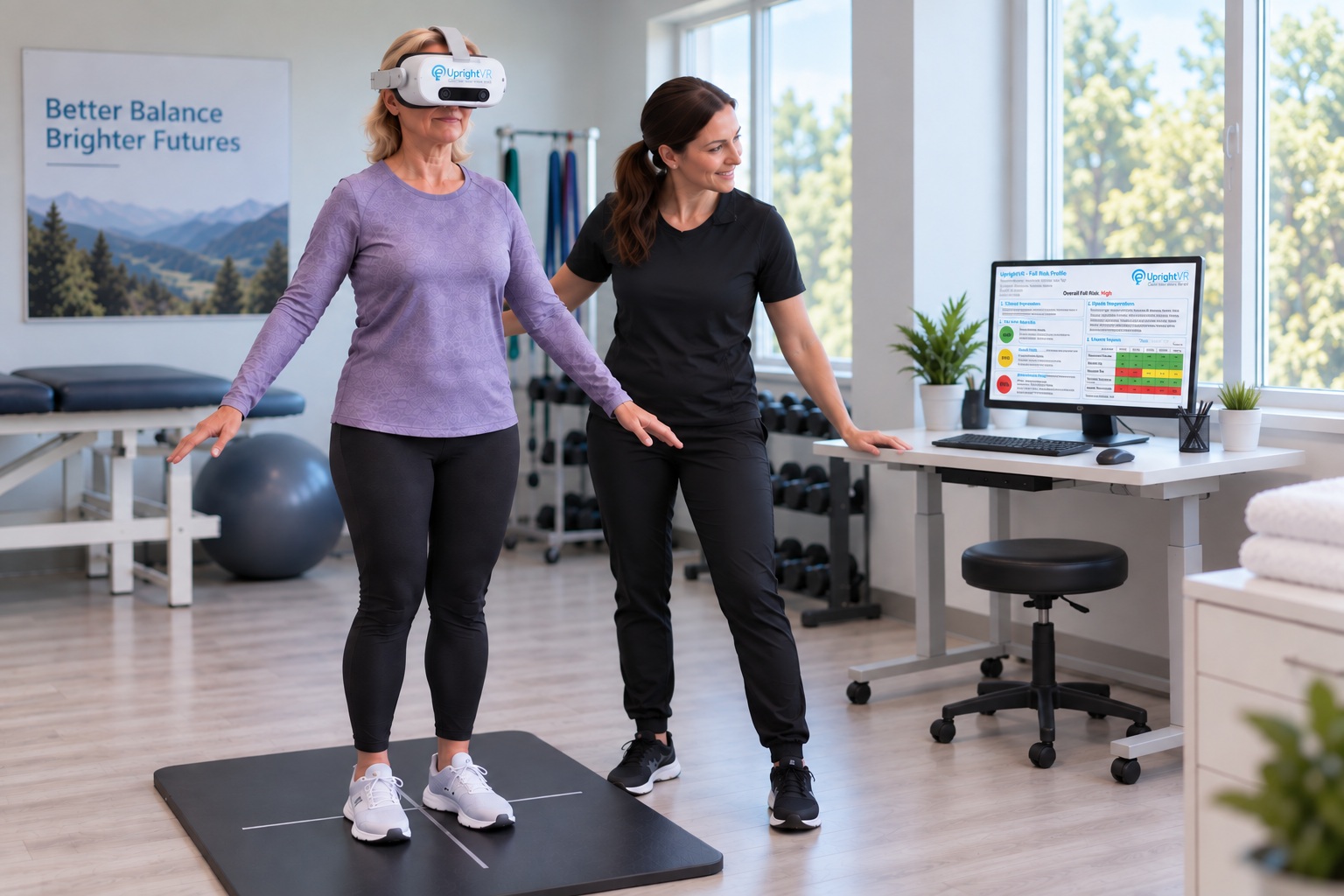
As rehabilitation technology continues to evolve, many physical therapists are exploring how virtual reality rehabilitation and objective balance assessment can help track meaningful progress with greater precision. By combining immersive rehabilitation environments with objective balance assessment and measurable performance data, clinicians may gain deeper insight into how patients are responding to treatment and whether rehabilitation is addressing the underlying causes of instability.
Key Takeaways
- Measuring progress in balance rehabilitation can be challenging because balance depends on multiple interacting sensory systems.
- Traditional outcome measures remain valuable but may not always identify the underlying contributors to instability.
- Virtual reality can help create standardized testing environments and support objective balance assessment.
- Sensory Organization Testing (SOT) and other instrumented assessments may help identify visual dependence, vestibular deficits, and sensory integration impairments.
- Objective outcome tracking can support clinical decision-making, patient engagement, and rehabilitation progression.
Why Measuring Progress in Balance Rehabilitation is Challenging
Balance is not a single skill.
It is the result of continuous interaction between visual, vestibular, and somatosensory systems, all working together to help us maintain stability and navigate our environment. Because multiple systems contribute to balance, measuring improvement is often more complicated than simply observing whether a patient can stand longer or walk farther.
Patients may demonstrate noticeable improvements in function while continuing to rely on compensatory strategies. Others may report feeling significantly better even though underlying impairments remain largely unchanged.
In some cases, the opposite is also true. A patient may feel frustrated by slow progress while objective measures reveal meaningful improvements in balance performance and sensory integration.
This complexity highlights an important reality:
Improvement and compensation are not always the same thing.
A patient may learn ways to work around an impairment without fully resolving the underlying deficit. Understanding the difference can help therapists make more informed treatment decisions and determine whether rehabilitation is producing meaningful physiological change.
Why Balance Impairment Is Not a Diagnosis
One of the challenges of measuring progress in balance rehabilitation is that balance impairment itself is not a diagnosis.
Instability may result from:
- Vestibular dysfunction
- Visual dependence
- Sensory integration impairments
- Somatosensory deficits
- Neurological conditions
- Concussion
- Age-related changes in sensory processing
Two patients may perform similarly during a traditional balance assessment while relying on very different balance strategies.
For example, one patient may rely heavily on visual information to maintain stability, while another may struggle to effectively utilize vestibular input. Although both patients may demonstrate similar levels of balance impairment, the underlying causes—and therefore the most effective interventions—may be entirely different.
This is why many physical therapists are moving beyond the question:
“Can the patient maintain balance?”
and instead asking:
- Why is balance impaired?
- Which sensory systems are contributing to instability?
- How does the patient respond when sensory information becomes unreliable?
- Is the patient becoming less dependent on compensatory strategies over time?
Answering these questions often requires more than observation alone.
Traditional Balance Outcome Measures Remain Valuable
Physical therapists have long relied on outcome measures such as the Berg Balance Scale, Timed Up and Go (TUG), Functional Gait Assessment (FGA), Dynamic Gait Index (DGI), and modified Clinical Test of Sensory Interaction on Balance (mCTSIB).
These assessments remain valuable tools for evaluating function, identifying fall risk, and monitoring change over time.
However, many traditional assessments provide valuable information about functional performance but may not fully explain the underlying factors contributing to instability.
For example:
- Did balance improve because vestibular function improved?
- Did the patient become less visually dependent?
- Has sensory integration improved?
- Is the patient relying on new compensatory strategies?
While traditional outcome measures can help identify whether performance has changed, they may not always reveal why that change occurred.
As balance rehabilitation becomes increasingly individualized, therapists are looking for ways to better understand the underlying systems contributing to patient performance.
What Physical Therapists Should Measure in Balance Rehabilitation
Vestibular Contribution to Balance
The vestibular system provides information about head movement, acceleration, and spatial orientation.
Patients with vestibular dysfunction may compensate effectively in simple environments while continuing to struggle in visually busy or dynamic settings.
Understanding how much a patient relies on vestibular input can help therapists develop more targeted interventions and better evaluate rehabilitation progress.
Visual Dependence and Balance
Some patients become overly reliant on vision to maintain balance.
This visual dependence often becomes apparent in environments with significant visual motion, such as grocery stores, airports, or crowded public spaces.
Measuring changes in visual dependence can help determine whether patients are becoming more adaptable and less reliant on compensatory strategies.
Somatosensory Contribution to Balance
The somatosensory system provides information from muscles, joints, and the feet regarding body position and movement.
When this system becomes impaired—or when patients rely on it excessively—balance performance may change significantly under different sensory conditions.
Sensory Reweighting in Balance Rehabilitation
Healthy individuals continuously adjust how much they rely on visual, vestibular, and somatosensory information depending on which source is most reliable.
This process is known as sensory reweighting.
Patients with vestibular disorders, concussion, neurological conditions, and balance impairments often struggle with this adaptation process.
Measuring sensory reweighting can provide valuable insight into rehabilitation progress that may not be visible through observation alone.
How Virtual Reality Rehabilitation Supports Objective Balance Assessment
One reason virtual reality rehabilitation is attracting attention is its ability to create controlled, repeatable, and measurable assessment environments.
Traditional balance testing often relies heavily on therapist observation and interpretation. While clinical expertise remains essential, observational assessments can introduce variability between clinicians and across testing sessions.
Virtual reality allows therapists to standardize testing conditions while collecting objective performance data.
Rather than relying solely on observational scoring, therapists can evaluate how patients respond when visual, vestibular, and somatosensory systems are challenged in consistent ways.
Potential benefits include:
- Standardized testing conditions
- Reduced assessment variability
- Objective performance measurement
- More consistent reassessment comparisons
- Improved outcome tracking over time
Importantly, technology does not replace clinical reasoning. Instead, it provides therapists with additional information that can support more informed decision-making, which can also reduce the cognitive load on clinicians already stretched to their limits.

Sensory Organization Testing for Balance Assessment
Historically, advanced balance assessment tools such as Sensory Organization Testing (SOT) were often available only at specialized balance centers or research facilities.
Advances in virtual reality technology are helping make these capabilities more accessible to outpatient rehabilitation clinics.
Sensory Organization Testing evaluates how patients use visual, vestibular, and somatosensory information to maintain balance under different sensory conditions.
By systematically altering sensory input, therapists can gain insight into:
- Visual dependence
- Vestibular contribution
- Somatosensory reliance
- Sensory integration deficits
- Fall risk factors
This type of information may help uncover impairments that are not always obvious during routine clinical assessment.
For therapists working with vestibular dysfunction, concussion, neurological conditions, and aging adults, these insights can support more targeted rehabilitation planning and more meaningful outcome tracking.
Why Objective Outcome Tracking Matters in Balance Rehabilitation
Objective data can help guide treatment progression, support reassessment decisions, and improve confidence in clinical decision-making.
Benefits for Therapists
Objective data can help guide treatment progression, support reassessment decisions, and improve confidence in clinical decision-making.
Benefits for Patients
Patients are often more motivated when they can visualize progress.
Rather than simply hearing that they are improving, patients can see measurable changes in performance over time. This may improve confidence, engagement, and adherence throughout rehabilitation.
Benefits for Rehabilitation Clinics
Healthcare continues to emphasize measurable outcomes and data-supported care.
Clinics are increasingly expected to demonstrate treatment effectiveness, track progress, and communicate outcomes to patients, referral sources, and stakeholders.
Objective outcome tracking can help support these goals while differentiating rehabilitation services in a competitive healthcare environment.
Final Thoughts
Measuring progress in vestibular and balance rehabilitation is rarely straightforward.
Because balance depends on the interaction of multiple sensory systems, meaningful improvements may not always be obvious through observation alone.
As rehabilitation continues moving toward measurable outcomes and data-supported care, many clinicians are exploring how virtual reality and objective balance assessment can provide deeper insight into patient performance and progress.
By combining clinical expertise with standardized assessment and measurable outcome tracking, therapists may be better equipped to identify underlying impairments, monitor meaningful change, and deliver more individualized rehabilitation programs.
Ultimately, better measurement can lead to better decisions—and better decisions can lead to better patient outcomes.
Frequently Asked Questions About Virtual Reality and Balance Assessment
How do physical therapists measure progress in balance rehabilitation?
Physical therapists often use a combination of outcome measures, patient-reported symptoms, functional performance testing, and clinical observation. Increasingly, clinics are also using objective balance assessment technologies to track measurable changes in performance over time.
What is a Sensory Organization Test (SOT)?
A Sensory Organization Test evaluates how effectively a person uses visual, vestibular, and somatosensory information to maintain balance. By manipulating sensory conditions, therapists can identify which systems may be contributing to instability.
Why is objective balance assessment important?
Objective balance assessment helps reduce variability, standardize testing conditions, and provide measurable performance data. This information can support treatment planning, progress tracking, and clinical decision-making.
Can vestibular dysfunction be measured objectively?
Many aspects of vestibular function can be evaluated through specialized assessment tools. Objective balance assessments may also help identify patterns consistent with vestibular impairment, visual dependence, and sensory integration deficits.
What is visual dependence?
Visual dependence occurs when an individual relies excessively on visual information for balance. Patients with visual dependence may experience dizziness, instability, or discomfort in visually busy environments such as grocery stores, shopping centers, or airports.
How often should balance assessments be repeated?
The frequency of reassessment depends on the patient, diagnosis, and plan of care. Many therapists perform reassessments periodically throughout rehabilitation to monitor progress and adjust treatment strategies as needed.
Can virtual reality help track rehabilitation outcomes?
Some virtual reality rehabilitation systems include objective assessment and outcome tracking capabilities. These tools may help therapists measure changes in balance performance, sensory integration, and patient progress throughout rehabilitation.