
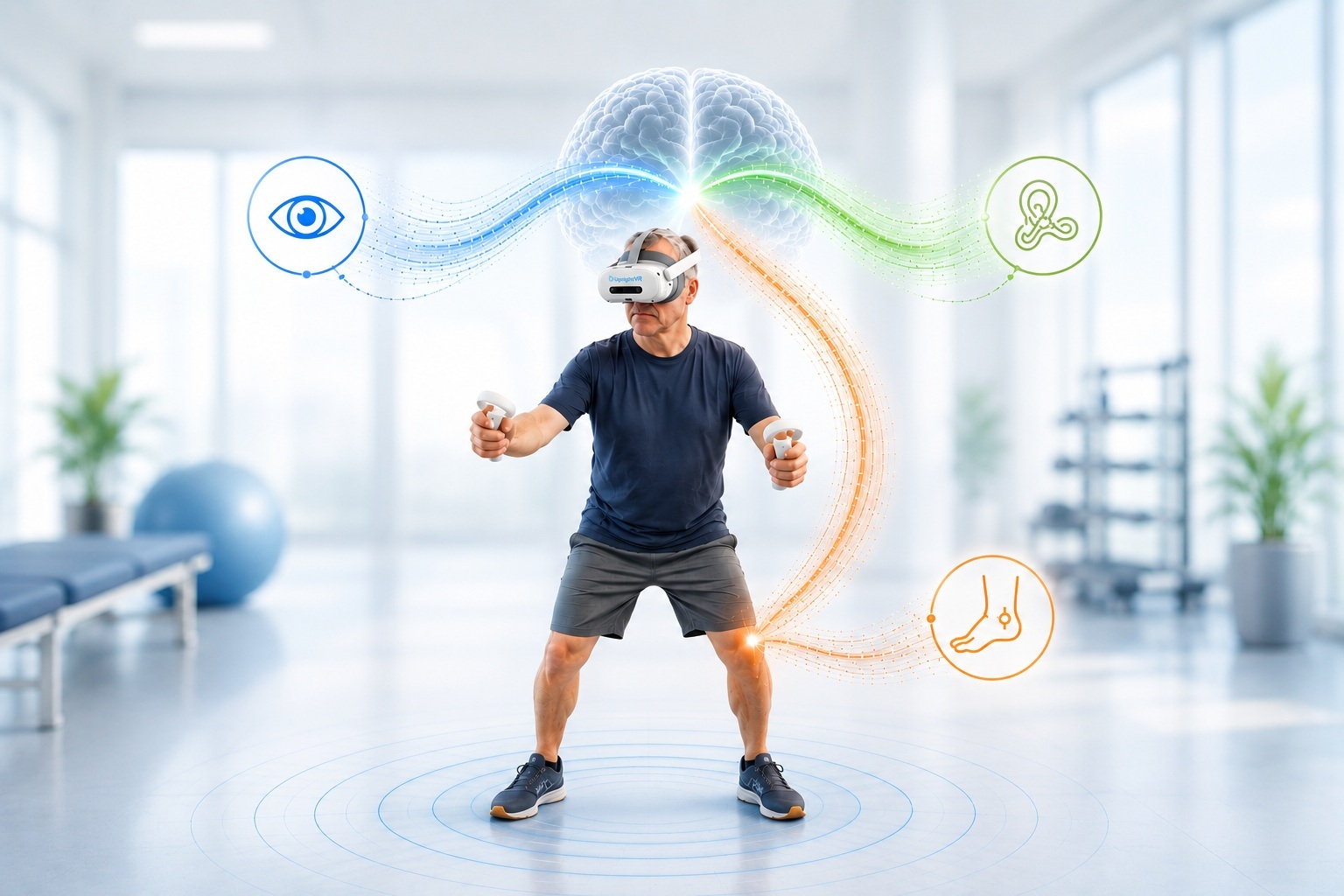
A patient performs well during routine balance testing in the clinic but reports feeling unsteady while shopping in a crowded grocery store. Another patient demonstrates normal gait and postural control during an evaluation yet struggles with dizziness and imbalance when standing in moving vehicles (subways, buses, boats).
These scenarios are not uncommon in physical therapy, PM&R, and geriatrics, particularly when treating vestibular disorders, neurological conditions, concussion, and older adults. They also highlight an important reality: balance is far more complex than simply standing upright without falling.
Successful balance depends on the brain’s ability to continuously gather, interpret, and integrate information from multiple sensory systems. When one of those systems becomes impaired—or when the brain struggles to process conflicting information—balance dysfunction can occur even when traditional testing appears relatively normal.
Understanding sensory integration is essential for clinicians seeking to improve balance assessment, identify underlying impairments, and develop more targeted rehabilitation strategies.
Key Takeaways
- Balance depends on visual, vestibular, and somatosensory systems working together.
- The brain continuously performs sensory reweighting to maintain stability.
- Patients may appear stable during routine testing while struggling with sensory conflict in real-world environments.
- Sensory integration deficits can contribute to dizziness, imbalance, and fall risk.
- Virtual reality can help clinicians create controlled sensory challenges while collecting objective performance data.
What is Sensory Integration?
Sensory integration refers to the brain’s ability to receive information from multiple sensory systems and combine that information into a meaningful response.The concept of sensory integration has been studied extensively in rehabilitation and neuroscience because it plays a critical role in how individuals interpret and respond to their environment.
When maintaining balance, the central nervous system is constantly processing input from three primary systems:
- The visual system
- The vestibular system
- The somatosensory system
These systems work together to help individuals understand where they are in space, how they are moving, and how they should respond to environmental demands.
When all three systems provide accurate information, balance feels effortless. When one system becomes unreliable, the brain must adapt and rely more heavily on the remaining systems to maintain stability.
This process is often referred to as sensory reweighting and plays a critical role in both balance rehabilitation and vestibular rehabilitation.
The Three Balance Systems
Each system contributes unique information that helps the brain maintain postural control and respond to changing environmental demands.
The Visual System
Vision provides information about the environment and our relationship to it. It helps us identify obstacles, perceive orientation, and determine whether we are stable or moving through space.
Visual information is particularly important when navigating unfamiliar environments or performing activities that require precise movement. Most people rely heavily on vision to maintain balance, often without realizing it.
While vision is extremely valuable, it can also become problematic when patients begin depending on it too heavily. Individuals with vestibular dysfunction frequently develop visual dependence, meaning they rely excessively on visual input to maintain stability.
As a result, visually busy environments such as grocery stores, shopping malls, airports, and crowded sidewalks may trigger dizziness, imbalance, or feelings of disorientation.
The Vestibular System
The vestibular system provides information about head movement, acceleration, and spatial orientation. Located within the inner ear, it acts as the body’s motion detection system.
Every time a patient turns their head, bends over, looks upward, or changes position, the vestibular system provides critical information that helps maintain stability and coordinate eye movements.
When vestibular function becomes impaired, patients often experience dizziness, imbalance, motion sensitivity, or difficulty navigating dynamic environments.
Because vestibular dysfunction can be subtle, patients may compensate effectively during simple balance tasks while continuing to struggle during real-world activities.
The Somatosensory System
The somatosensory system provides information from muscles, joints, ligaments, and the feet. It allows the brain to understand body position and movement without relying solely on the other senses.
This system helps patients recognize whether they are standing on a firm surface, shifting their weight appropriately, or responding to changes in terrain.
Conditions such as peripheral neuropathy, orthopedic injury, aging, and neurological disorders can reduce the accuracy of somatosensory feedback, forcing the brain to rely more heavily on vision or vestibular input.
Why Sensory Reweighting Matters in Balance Rehabilitation
The brain does not treat all sensory information equally. Instead, it continuously evaluates which source of information is most reliable and adjusts accordingly.
Consider walking through a well-lit hallway. Visual information is highly reliable, allowing the brain to use it extensively for balance control. Now imagine walking through the same hallway during a power outage. Visual information becomes less useful, forcing the brain to rely more heavily on vestibular and somatosensory input. This process of dynamically adjusting reliance on different sensory systems is known as sensory reweighting.
Healthy individuals perform sensory reweighting automatically and efficiently. Patients with vestibular disorders, concussion, neurological conditions, or sensory integration deficits often struggle with this process.
As a result, they may remain stable under one set of conditions while demonstrating significant balance impairments when sensory demands change.
Why Balance Deficits Are Often Missed
Many balance assessments and balance protocols are performed in quiet, predictable clinical environments. While these assessments remain valuable, they may not fully capture how patients function in the real world. This challenge becomes even more significant when multiple therapists are evaluating the same patient, as subtle sensory integration deficits may be interpreted differently depending on clinician experience and training.
Patients frequently develop compensatory strategies that allow them to perform well during routine testing. However, those same patients may experience significant difficulties when visual motion increases, environmental complexity rises, or sensory conflict is introduced.
For example, a patient may demonstrate normal balance while standing quietly on a firm surface but struggle significantly when visual information becomes unreliable or distracting.
This is one reason balance impairment can be challenging to identify through observation alone. In fact, many of the limitations stem from the subjective nature of traditional balance assessment methods.
The underlying problem may not be whether a patient can maintain balance under ideal conditions. The more important question is often whether they can maintain balance when sensory information becomes incomplete, inaccurate, or conflicting.
The Role of Sensory Conflict in Physical Therapy
Sensory conflict occurs when the information provided by one sensory system disagrees with information coming from another system.
Common Examples of Sensory Conflict:
- Watching a subway pass
- Navigating a dark room
- Standing on foam with eyes closed
- Walking through a crowded grocery store
- Turning the head while walking
- Walking on uneven terrain
Physical therapists frequently use sensory conflict to identify impairments and improve sensory integration.
A simple example is standing on a foam surface with the eyes closed. The foam reduces the reliability of somatosensory feedback while the closed eyes remove visual input. This forces greater reliance on vestibular information. This concept forms the foundation of clinical assessments such as the Modified Clinical Test of Sensory Interaction on Balance (mCTSIB), which is commonly used to evaluate how patients process sensory information for balance control.
By systematically manipulating sensory input, therapists can gain valuable insight into which systems are contributing to balance impairment and develop more targeted interventions.
Traditionally, therapists have challenged sensory systems using tools such as foam surfaces, visual occlusion, head movement tasks, and dual-task activities. These approaches remain valuable, but advances in rehabilitation technology are creating new opportunities to systematically assess and challenge sensory integration in controlled and repeatable ways.
How Virtual Reality Supports Sensory Integration Training
As rehabilitation technology continues to evolve, many physical therapists are exploring how virtual reality can support sensory integration and balance rehabilitation.
One advantage of virtual reality rehabilitation in vestibular rehabilitation and balance training is the ability to create controlled sensory challenges that are difficult to reproduce consistently in traditional clinical environments.
Rather than relying solely on static balance tasks, clinicians can introduce visual motion, environmental complexity, cognitive demands, and sensory conflict in a standardized and repeatable manner.
This allows clinicians to observe how patients respond when sensory systems are challenged while maintaining a safe and controlled environment. Some rehabilitation platforms also combine immersive training with objective balance assessment, allowing clinicians to gather measurable data while challenging visual, vestibular, and somatosensory systems.
Virtual reality may also help uncover impairments that are not always apparent during traditional balance assessments. Patients who appear stable under basic testing conditions may demonstrate significant challenges when visual motion, dual-task demands, or environmental distractions are introduced.
For clinicians focused on measurable outcomes and individualized treatment progression, these capabilities may provide valuable insight into patient performance and rehabilitation progress. This approach reflects a broader trend toward instrumented balance assessment, where clinicians use technology to quantify performance and identify subtle impairments that may be difficult to detect through observation alone.
Beyond assessment and progression, clinicians are also challenged by patient motivation and consistency throughout rehabilitation. Many balance and vestibular rehabilitation programs require significant repetition over time, making patient engagement an important contributor to overall outcomes. Understanding how participation influences treatment success is an important consideration for clinics seeking to improve both outcomes and plan-of-care completion.

The Future of Balance and Vestibular Rehabilitation
Balance rehabilitation continues to evolve as clinicians gain a deeper understanding of sensory integration, motor learning, and neuroplasticity.
While traditional balance assessments remain important, many therapists are recognizing the value of identifying the underlying systems contributing to instability rather than focusing solely on observable performance.
Understanding how visual, vestibular, and somatosensory systems interact with motor responses needed to balance and walk allows clinicians to develop more targeted interventions, improve treatment progression, and better address the unique needs of each patient.
However, identifying sensory integration deficits is only part of the rehabilitation process. Clinicians must also be able to track whether patients are making meaningful improvements over time.
As healthcare continues emphasizing objective outcomes, individualized care, and evidence-based practice, tools that help clinicians assess and challenge sensory integration may play an increasingly important role in rehabilitation.
Final Thoughts
Balance is not controlled by a single system. It is the result of continuous communication between visual, vestibular, and somatosensory inputs that must be interpreted and integrated by the brain in real time. This leads to appropriate and adaptive motor behavior that maintains postural control and allows for successful interaction with the environment.
When clinicians understand how sensory integration influences balance, they can move beyond simply identifying instability and begin uncovering why it occurs.
That deeper understanding often leads to more precise assessments, more targeted interventions, and ultimately better outcomes for patients working to regain confidence, mobility, and independence.
Frequently Asked Questions About Sensory Integration and Balance Rehabilitation
What is sensory integration in physical therapy?
Sensory integration refers to the brain’s ability to receive, interpret, and combine information from multiple sensory systems to guide movement and maintain balance. In physical therapy, sensory integration is particularly important when treating patients with vestibular disorders, neurological conditions, concussion, balance impairments, and fall risk. Effective rehabilitation often involves identifying which sensory systems are contributing to instability and helping patients improve how those systems work together.
What are the three systems involved in balance?
Balance depends primarily on three sensory systems: the visual system, the vestibular system, and the somatosensory system. The visual system provides information about the environment and movement, the vestibular system detects head movement and spatial orientation, and the somatosensory system provides feedback from muscles, joints, and the feet. The brain continuously integrates information from all three systems to maintain postural control and orientation.
What is sensory reweighting?
Sensory reweighting is the process by which the brain adjusts its reliance on different sensory systems based on which source of information is most reliable at a given moment. For example, when walking in a dark environment, visual input becomes less reliable and the brain must rely more heavily on vestibular and somatosensory information. Patients with vestibular dysfunction, concussion, or neurological conditions may have difficulty with sensory reweighting, which can contribute to balance impairments and dizziness.
Why do some patients feel dizzy or unsteady in busy environments?
Many patients who experience dizziness in grocery stores, shopping centers, airports, or crowded environments have difficulty processing complex visual information. This is often referred to as visual dependence. These patients may rely too heavily on visual input for balance and become overwhelmed when visual motion or environmental complexity increases. Identifying visual dependence can help therapists develop more targeted vestibular and balance rehabilitation programs.
How does virtual reality support sensory integration training?
Virtual reality allows therapists to create controlled environments that challenge visual, vestibular, and somatosensory systems in ways that can be difficult to replicate consistently in traditional clinical settings. By introducing visual motion, environmental complexity, sensory conflict, and cognitive demands, virtual reality may help clinicians identify sensory integration deficits, progress rehabilitation exercises, and provide measurable feedback throughout the rehabilitation process.
Can balance deficits be missed during traditional balance testing?
Yes. Some patients compensate effectively during routine balance assessments and may appear stable under straightforward testing conditions. However, those same patients may struggle when sensory information becomes unreliable or conflicting. This is one reason therapists often use sensory integration testing, sensory conflict activities, and more advanced balance assessments to uncover impairments that may not be obvious through observation alone. Objective balance assessment tools may also help clinicians identify subtle deficits and track meaningful changes over time.
Is sensory integration training effective for vestibular rehabilitation?
Sensory integration training is a common component of vestibular rehabilitation because many vestibular disorders affect how the brain processes and utilizes sensory information for balance and spatial orientation. Patients with vestibular dysfunction often become overly reliant on vision or may have difficulty adapting when sensory conditions change. By systematically challenging visual, vestibular, and somatosensory systems, therapists can help patients improve sensory reweighting, reduce visual dependence, and develop more effective balance strategies. Modern rehabilitation technologies may also help clinicians create controlled sensory challenges while providing objective feedback and measurable outcome data throughout the rehabilitation process.